AutoExplore AI Integration: Exporting Findings for Better Root Cause Analysis
We are building an export workflow that moves AutoExplore issue evidence out of the testing environment so teams can enrich it with source-code context, improve root cause analysis, write better backlog tickets, and generate stronger AI-assisted fix ideas.

Sampo Kivistö
Founder & CEO
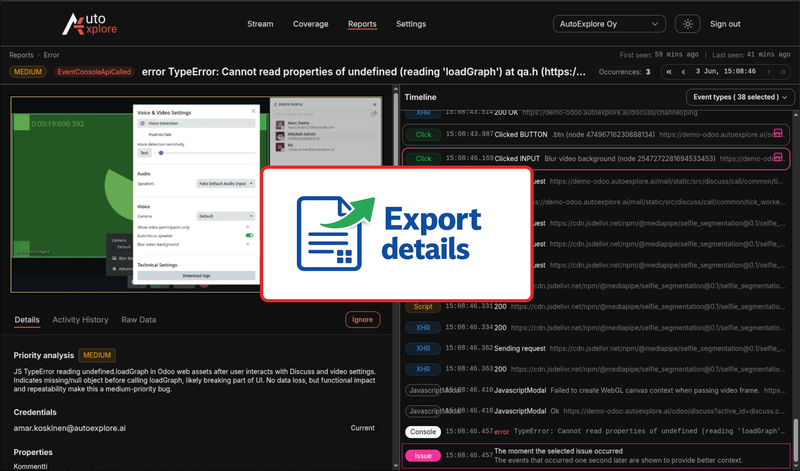
AutoExplore already helps teams find issues from the browser side. It explores the application, records the steps, captures screenshots, and preserves the timeline around the problem. That shortens the distance between "something is broken" and "we can reproduce it."
But reproduction is not the same as root cause analysis.
For many teams, the slowest part starts after the issue is already visible. Someone has to take the AutoExplore finding, understand what was happening in the UI, move that context into engineering workflow, inspect the source code, connect the issue to recent changes, and write a ticket that is useful enough for implementation.
That handoff is exactly where we are currently focusing our next integration work.
AutoExplore already captures the hard evidence
AutoExplore issue reports already include the kind of evidence teams need for the first stage of investigation:
- agent steps leading to the problem
- screenshots from the timeline
- technical issue details
- occurrence grouping across similar failures
- surrounding context about what happened before and after the issue
Related: AutoExplore issue reporting.
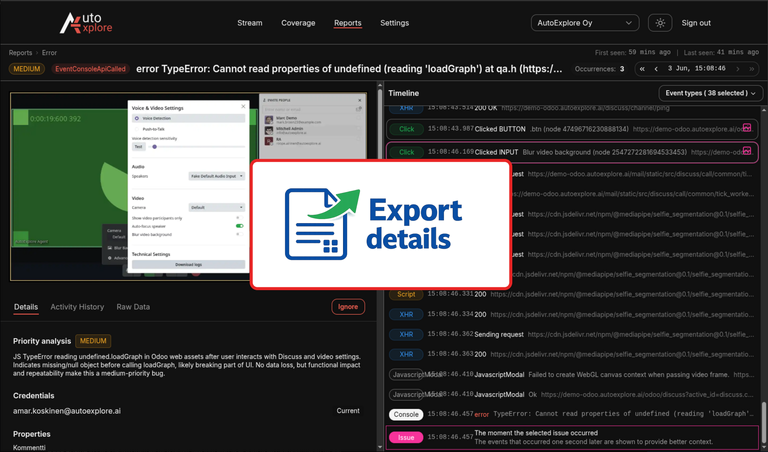
This is already enough to make many issues reproducible without a long Slack thread or a live walkthrough. The missing piece is what happens next when the team wants to move from browser evidence to implementation-level understanding.
The gap between finding and fixing
A browser-level finding tells you that a user-visible problem happened. It does not automatically tell you which commit introduced it, which component is most likely responsible, or whether the failure is connected to a recent API contract change, state-management bug, validation rule, or rendering regression.
That gap creates predictable waste:
- QA or engineering rewrites the same issue context into another system
- developers manually gather source-code clues that should sit next to the original evidence
- backlog tickets become too shallow to support fast implementation
- teams spend triage time reconstructing context instead of solving the problem
This is especially painful when the issue is intermittent, appears only after a longer interaction chain, or depends on timing between requests and UI state.
What we are building now
We are working on export functionality that moves selected AutoExplore findings out of the AutoExplore environment so they can be enriched with source-code data.
The goal is not to replace AutoExplore reporting. The goal is to extend it into a stronger engineering workflow.
In practice, this means the AutoExplore finding becomes the starting evidence bundle, not the final artifact. Once exported, that bundle can be combined with source-code context and used to build a better root-cause hypothesis than UI evidence alone can provide.
How the workflow is intended to work
The workflow we are building looks like this:
- AutoExplore agent runs 24/7 and at some point finds an issue.
- The selected finding is exported out of AutoExplore in a structured format.
- That exported package is enriched with source-code-side information.
- The combined result is used to form a stronger root-cause analysis.
- The output is turned into a more informative backlog ticket, including AI-generated fix ideas as a starting point for engineering review.
The important shift is that the engineering team does not start from a blank ticket anymore. They start from a ticket candidate that already contains reproduction evidence, failure context, and an initial implementation-oriented hypothesis.
Better backlog tickets, not just more tickets
One reason defects move slowly through engineering organizations is that the first ticket is often too weak. It might describe the visible symptom, but not the operating conditions, the likely affected area, or the technical hypothesis.
We want the export workflow to improve ticket quality in three ways:
- better reproduction context from the original AutoExplore timeline
- better engineering context from source-code enrichment
- better starting proposals from AI-generated suggested fixes
That does not mean the AI writes production-ready fixes automatically. It means the team gets a higher quality starting point:
- a clearer issue summary
- stronger root-cause hints
- suggested areas to inspect first
- implementation ideas that can be reviewed, corrected, or rejected by engineers
For many teams, that is enough to remove a large amount of repetitive triage work.
Human review still matters
This integration work is about better decision support, not blind automation.
AI-generated fix suggestions are still suggestions. They need engineering review. They can help narrow the search space, propose likely failure modes, and outline candidate implementation directions, but they should not bypass normal code review or technical judgment.
The same applies to root-cause hypotheses. The purpose of the export workflow is to make the first hypothesis better informed, not to pretend uncertainty does not exist.
Where we are now
This export and enrichment workflow is currently under development. We are building it because we see the same pattern repeatedly: finding the issue is only the first half of the job, and teams need stronger support for the second half.
AutoExplore already gives teams high-quality browser evidence. The next step is making that evidence travel better into engineering systems and become more useful for implementation work.
If this is close to how your team wants to work with autonomous testing, book a demo. We are happy to show the current reporting workflow and discuss the direction of the export functionality with teams that want better root-cause analysis and better backlog tickets from autonomous findings.